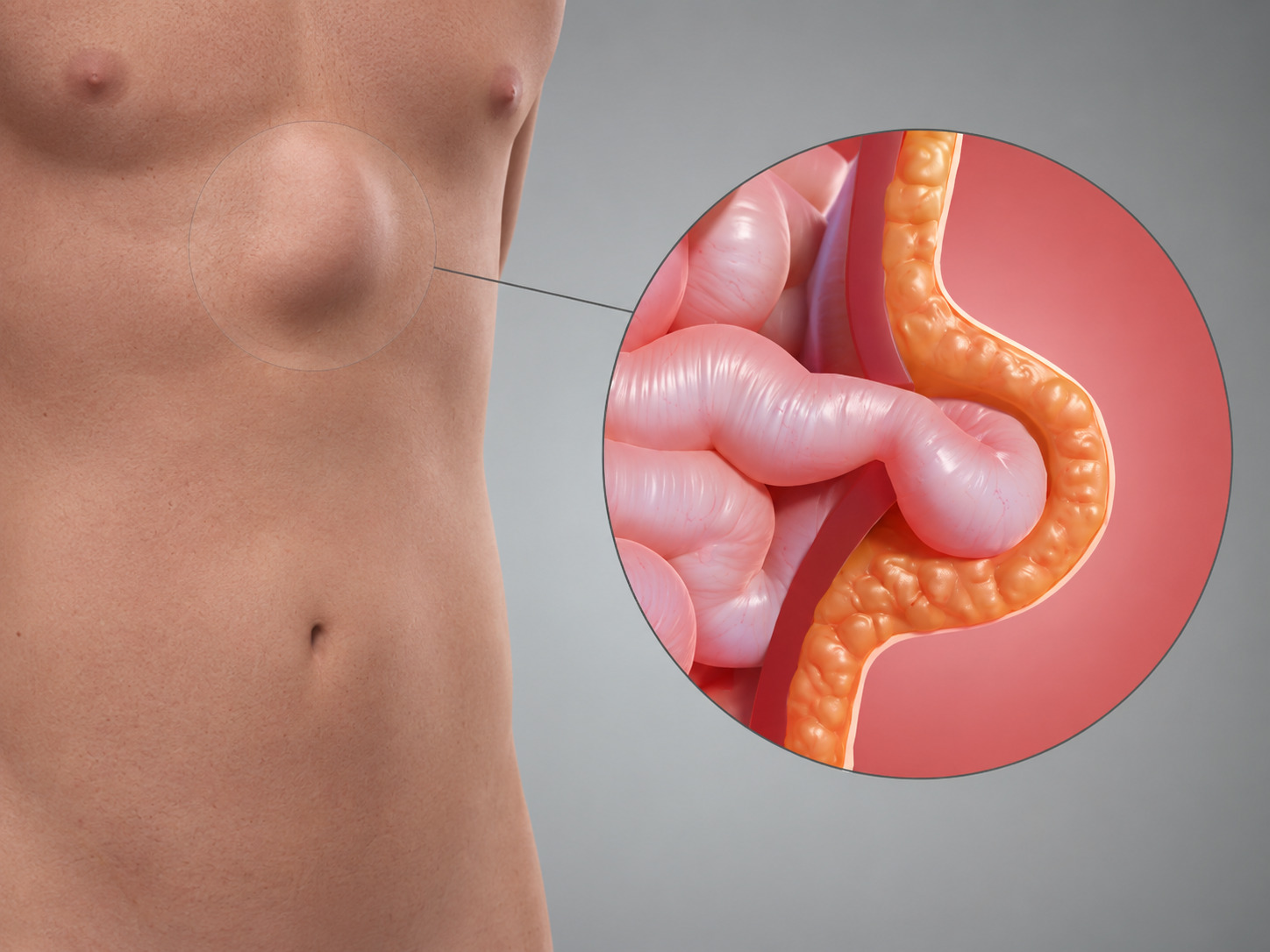
An epigastric hernia appears in the upper middle of the abdomen, between the navel and the breastbone, where the abdominal wall is naturally thinner. SurgiKure Healthcare repairs it with advanced laparoscopic (keyhole) surgery and mesh reinforcement.
What is an Epigastric Hernia?
An epigastric hernia occurs when fat or tissue pushes through a weak spot in the midline of the upper abdomen, between the belly button and the lower end of the breastbone. These hernias are often small and may contain only fatty tissue rather than bowel, but they can still cause a visible bump and localised, nagging pain — especially when you cough, lift or strain.
Symptoms to Watch For
- A small lump or bulge in the upper-central abdomen
- Aching or sharp pain above the navel, worse on straining
- Discomfort when coughing, lifting or bending
- Tenderness over the bulge
- Multiple small hernias occurring along the midline
Why Treatment Matters
Epigastric hernias do not heal on their own and tend to enlarge over time. Left untreated, the trapped fat can become painful or, rarely, a loop of bowel can become stuck (incarcerated). A planned laparoscopic repair is a straightforward, low-risk day-care procedure that resolves the problem permanently.
Epigastric Hernia Treatment at SurgiKure
At SurgiKure, epigastric hernias are repaired laparoscopically through three tiny keyhole incisions. A fine camera guides the surgeon, the defect is closed, and a strong prosthetic mesh is placed to reinforce the abdominal wall — reducing recurrence to under 1%. Most patients go home the same day and return to desk work within 3–5 days.
- Keyhole (laparoscopic) surgery — tiny cuts, minimal pain
- Strong mesh repair — recurrence under 1%
- Same-day discharge for most patients
- Insurance cashless support handled for you
- Free follow-up care included
Ready to Consult a Hernia Specialist?
Free first consultation with Dr. Polisetti Ramachandra Rao. Same-day appointments available.